

You know you want to start a business. You’ve been watching YouTube videos, scrolling through Reddit threads, and bookmarking “how to start a dropshipping store” guides for months. But every time you get close to committing, another video pops up telling you that model is “dead” or “too saturated.”
So you stay stuck. Another week passes. Then another month.
Here’s what staying in research mode actually costs you: momentum. Every day you spend analyzing options is a day you’re not building an audience, not making a sale, and not moving one inch closer to escaping the 9-to-5.
The truth is, there is no “perfect” business model. There is only the one you actually start.
In this post, I’m breaking down 7 business models that are working right now in 2026—specifically for beginners. I’ve helped over 500 students launch their first online businesses, and I’ve seen firsthand which models get results fast and which leave people stuck. By the end, you’ll have a clear framework to choose the right model for YOUR situation and a 3-day plan to launch it.

Soft Gate: Get the 7-Model Comparison Matrix
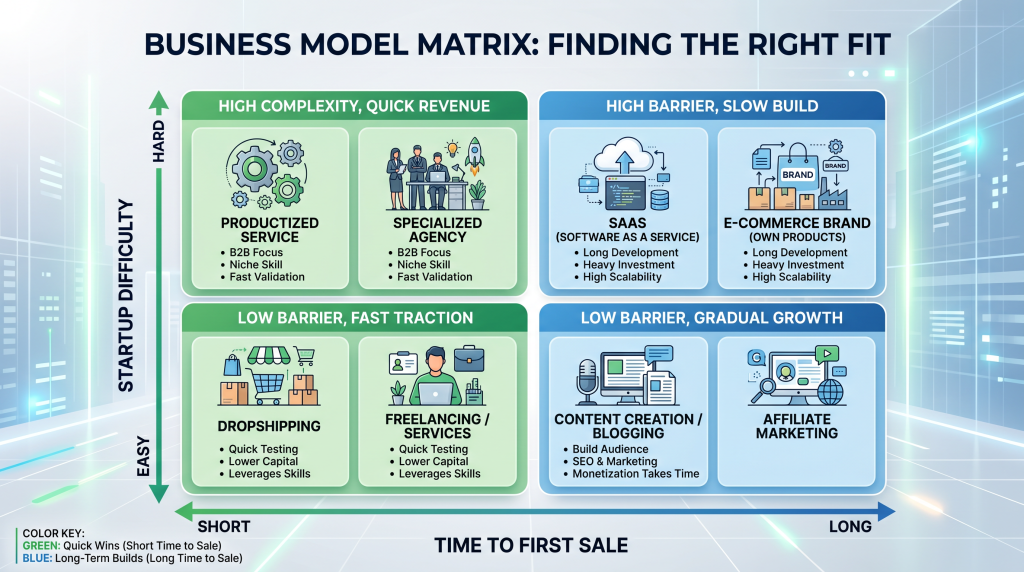
Before we dive into the models, I want to give you a tool to make this easier. I’ve created a free 7-Model Comparison Matrix PDF that breaks down every model we’re about to cover—including startup costs, time to first sale, income potential, and skill requirements—all on one page.
It’s the cheat sheet I wish I had when I was starting out.
[Click here to grab your free 7-Model Comparison Matrix.]
How to Choose the Right Model for YOU (Before We Dive In)
Before I list the 7 models, let’s get honest about YOUR situation. The “best” model isn’t the one with the highest income ceiling—it’s the one that fits your life right now.
Ask yourself these 4 questions:
| Question | Why It Matters |
|---|---|
| How much time do you have? | 5 hours/week vs. 20 hours/week changes what’s realistic |
| What skills do you already have? | Writing? Talking? Organizing? Use what you’ve got |
| How fast do you need income? | Side hustle money in 30 days vs. building for 6 months |
| What energizes you? | Working alone vs. talking to clients vs. creating content |
Keep your answers in mind as we go through each model. I’ll call out which models align with different answers.
#1: AI-Enhanced Service Provider
What It Is: You offer a traditional service (copywriting, social media management, virtual assistance, resume writing) but use AI tools to do the work 10x faster than competitors.
Why It Works in 2026: Businesses are desperate to cut costs but still need results. By using AI, you can charge premium rates while delivering work in hours instead of days. You’re not competing on price—you’re competing on speed.
AI Advantage: ChatGPT writes drafts, Canva AI creates graphics, and tools like Opus Clip edit videos. You act as the quality control and the human touch. One person with AI can now do the work of a 5-person agency.
Income Potential: $500–$5,000/month part-time. Scale by raising prices or hiring help.
Best For: People who already have a skill (writing, organizing, scheduling) but want to monetize it faster. Also great for natural communicators who enjoy helping others.
Example: Jessica was a teacher who became a “Done-For-You Lesson Plan Creator.” She uses AI to generate 20 differentiated lesson plans in 2 hours. She sells monthly subscriptions to busy teachers for $97/month. She now has 47 clients and works 10 hours/week.
#2: Digital Product Creator
What It Is: You create and sell downloadable products like templates, prompts, planners, ebooks, or worksheets. Customers buy them, download them instantly, and you never touch them again.
Why It Works in 2026: Digital products are the ultimate passive income model. Create once, sell forever. Platforms like Gumroad, Etsy, and Stan Store have made selling to a global audience effortless.
AI Advantage: You don’t need to be a designer or writer. Use AI to:
Income Potential: $200–$3,000/month with one product. Scale by adding more products or driving more traffic.
Best For: People who enjoy creating structure, have niche interests, or want a true “set it and forget it” model. Perfect for introverts.
Example: A former nurse created a “ChatGPT Prompts for Nurses” digital product pack. She spent 3 hours putting it together, listed it on Etsy for $12, and now sells 50–100 copies per month without any active marketing.
#3: Micro-SaaS or Tool-Based Business
What It Is: You build a simple software tool—usually a “one-trick pony”—that solves a specific problem. Think calculators, generators, schedulers, or automation tools.
Why It Works in 2026: No-code tools like Bubble, Glide, and Softr have made it possible for non-developers to build functional software. You don’t need to know code. You need to know a problem.
AI Advantage: Use AI to help with the no-code build (Cline, v0), write your copy, and generate marketing content. AI can also help you validate the idea before you build anything.
Income Potential: $500–$10,000/month. Micro-SaaS often uses subscription pricing ($9–$49/month), so 100 paying customers can be life-changing.
Best For: Problem-solvers who enjoy building things. People who see inefficiencies and think, “There should be a tool for that.”
Example: A former project manager built a “Meeting Cost Calculator” using Glide. It’s a simple tool that shows companies how much money they waste in meetings. She added a paid version for $19/month to remove branding. She now has 300+ paying customers.
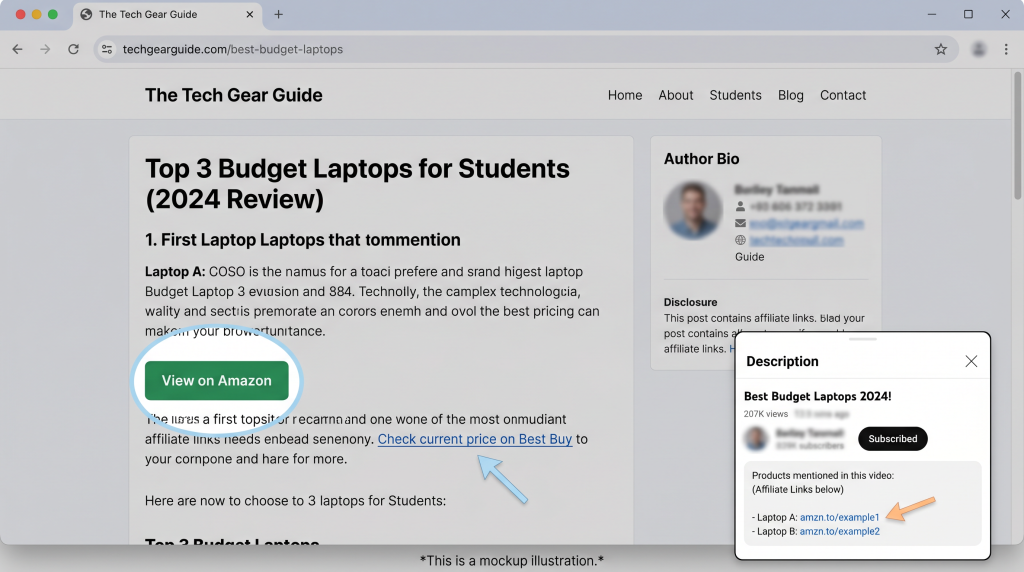
#4: Affiliate Content Site
What It Is: You create content (blog posts, YouTube videos, TikTok reviews) that recommends products. When someone buys through your unique link, you earn a commission (usually 5–30%).
Why It Works in 2026: People trust recommendations from real humans more than ads. With AI, you can scale content production faster than ever. The “creator economy” is booming, and brands are competing for affiliates.
AI Advantage: AI writes blog posts, creates video scripts, generates thumbnails, and even produces faceless video content. You can build a content machine that runs on autopilot.
Income Potential: $100–$5,000/month in first year. Scales with traffic. Top affiliates make six figures.
Best For: People who enjoy researching, testing products, or teaching. Great for anyone with a specific interest (outdoor gear, parenting, productivity tools).
Example: A college student started a blog about “Best Budget Gear for Camping.” She uses AI to write detailed product roundups, joins Amazon Associates and REI’s affiliate program, and now earns $800–$1,200/month while studying.
#5: Done-For-You AI Services
What It Is: You offer to do for clients what they don’t know how to do themselves—using AI tools. Examples: AI-generated lead lists, AI-optimized resumes, AI video creation, AI social media management.
Why It Works in 2026: The average business owner knows AI exists but has no idea how to use it effectively. They’re willing to pay someone who does.
AI Advantage: This is the ultimate “tool-based arbitrage.” You learn one AI tool deeply, then offer it as a service. The barrier to entry is learning, not skill.
Income Potential: $1,000–$8,000/month. Service-based pricing scales with clients, not traffic.
Best For: People who enjoy client interaction, want fast income, and are comfortable learning new tools quickly.
Example: A former HR assistant learned how to use AI resume builders and LinkedIn optimization tools. She now offers “AI Resume Makeovers” for $150 each. She gets clients through Upwork and referrals, doing 5–10 per week.
#6: Cohort-Based Courses or Communities
What It Is: You teach a skill or bring people together around a shared goal. Instead of a pre-recorded course, you run live cohorts (small groups) where you teach and support participants in real time.
Why It Works in 2026: People are tired of pre-recorded courses they never finish. Live cohorts create accountability, connection, and results—which means higher prices and better testimonials.
AI Advantage: Use AI to:
Income Potential: $2,000–$15,000 per cohort. Run 3–4 cohorts per year.
Best For: People who already have expertise in a specific area (career, hobby, skill) and enjoy teaching and community building.
Example: A graphic designer launched a “Learn Canva in 30 Days” live cohort. She charges $297 per person, runs cohorts of 25 students, and makes over $7,000 every quarter.
#7: E-commerce with AI-Generated Products (Print-on-Demand)
What It Is: You design t-shirts, mugs, phone cases, or other merchandise using AI, list them on platforms like Redbubble, Printful, or Etsy, and a third party prints and ships when an order comes in.
Why It Works in 2026: AI design tools like Midjourney, Leonardo AI, and Canva AI have made it possible for anyone to create professional, unique designs without artistic skill. Print-on-demand means zero inventory risk.
AI Advantage: You can generate 50 unique, high-quality design concepts in an hour. What used to take weeks of sketching now takes minutes of prompting.
Income Potential: $200–$3,000/month. Scales with number of designs and traffic.
Best For: Creative people who want to express themselves. Great for tapping into niche interests (dog breeds, hobbies, funny quotes).
Example: A former retail worker started a print-on-demand store focused on “Obscure Book Lover” t-shirts. She uses AI to generate witty book-themed designs, lists them on Etsy, and now sells 30–50 shirts per month.
The 2026 Factor – What’s Different This Year
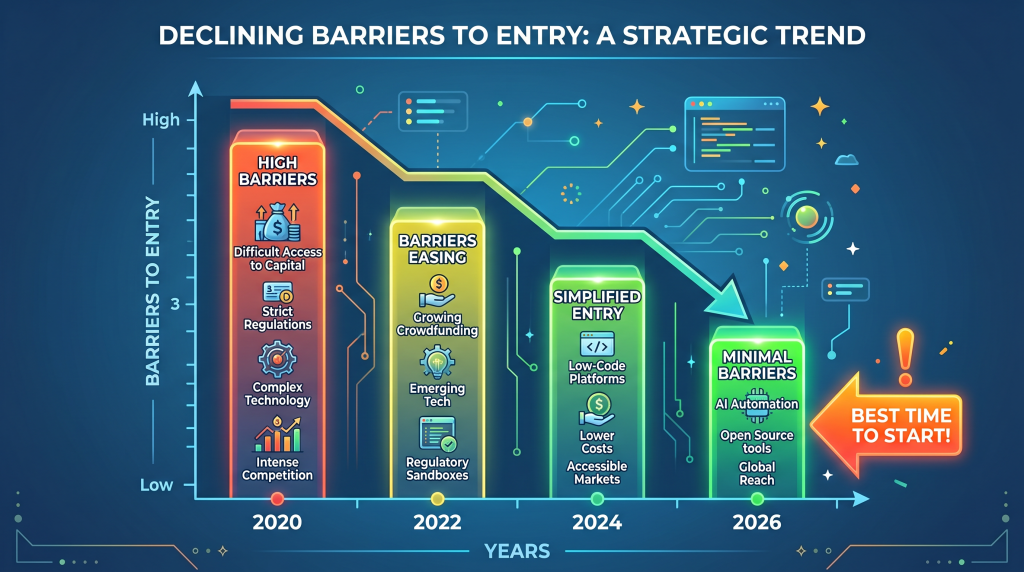
If you were reading a post like this in 2020, you’d be looking at models that required months of learning, thousands of dollars in startup costs, and specialized skills.
2026 is different for three reasons:
1. AI Democratized Creation: Tools that used to cost thousands (design, copy, video) are now free or cheap. One person with AI can launch what used to require a team.
2. No-Code Eliminated Technical Barriers: You don’t need to be a developer anymore. If you can use a spreadsheet, you can launch a SaaS or website.
3. Consumers Expect AI-Enhanced Products: The market has normalized AI. Buyers don’t care if you used AI to create something—they care if it solves their problem.
The barriers that kept beginners out for decades have crumbled. There has never been a better time to start with less experience.
How to Pick One and Start This Week
You have 7 models. Now it’s time to stop analyzing and start doing. Here’s your 3-day action plan:
Day 1: Choose One Model
Day 2: Set Up Minimal Tools
Day 3: First Outreach or Content
The goal isn’t perfection. The goal is to break the cycle of analysis paralysis.
The best business model is the one you actually start.
Aslam Ssonko
Objection Handler
Objection 1: “What if I pick the wrong model?”
You can’t pick the wrong model because you’re not locked in. The goal of your first business is not to build an empire—it’s to learn. You learn faster by doing one model than by researching seven. If it’s not the right fit, you pivot. You haven’t wasted time; you’ve gained experience.
Objection 2: “Aren’t these markets saturated?”
“Saturation” is what people say when they’re looking for excuses not to start. There is always room for someone who does it better, serves a specific niche, or simply shows up consistently. You don’t need to be the best. You need to be in the game.
Objection 3: “I don’t have the skills for any of these.”
Every model on this list has an AI advantage. You don’t need to be a writer, designer, or developer. You need to be the person who takes action and uses the tools available. The skills you need are: curiosity, consistency, and the willingness to learn by doing.
You now have 7 proven models, a framework to choose the right one, and a 3-day plan to start. The only thing standing between you and your first sale is the decision to take action.
But I know that reading this and doing it are two different things. That’s why I created a resource to help you take that first step with clarity.
Take the Free Business Model Match Quiz (Benefit-Focused)
Problem Recap: You’re stuck in analysis paralysis. You’ve been researching business models for weeks or months, but you haven’t started because you’re afraid of picking the “wrong” one. Meanwhile, time keeps passing.
Solution: I’ve created a free Business Model Match Quiz that takes your answers about time, skills, income needs, and personality and tells you exactly which model from this list is best for you. Plus, when you take the quiz, you’ll get instant access to my 7-Day Business Starter Email Course—a day-by-day guide to launching your chosen model.
Action: Stop researching and start doing. Click the button below, take the 2-minute quiz, and get your personalized recommendation.
[Take the Free Business Model Match Quiz →]
P.S
Here’s the thing about analysis paralysis: it feels safe, but it’s actually the riskiest move you can make. Every week you spend researching is a week of income you’ll never get back. The 7 models above aren’t going anywhere. But your momentum? That’s fading every day you wait. Take the quiz. Pick one. Start today.