


You want to start a digital business. You’ve watched the YouTube videos, read the Reddit threads, and bookmarked the “10 Steps to $10,000” articles. But the more you learn, the more confused you get.
One expert says you need a newsletter. Another says TikTok is the only way. Someone else swears by dropshipping. Then there’s the tech overwhelm—funnels, domains, hosting, email marketing platforms, CRM, SEO, analytics. It feels like you need to learn a dozen new skills just to get started.
And underneath it all is the fear: What if I fail? What if I waste months building something nobody wants?
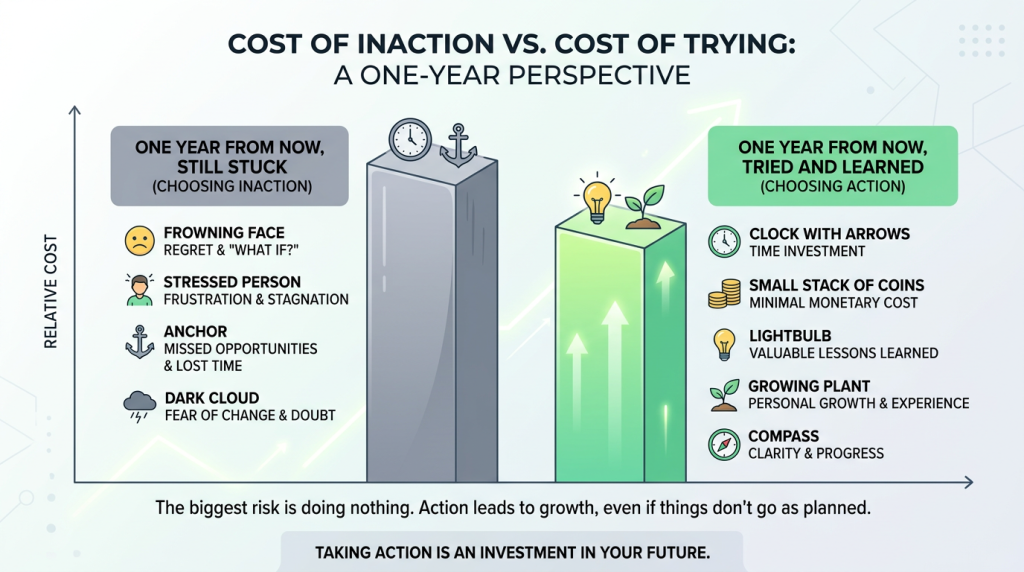
Here’s what staying stuck actually costs you: another year in the same place. Another year of wondering “what if.” Another year of freedom, fulfillment, and financial potential slipping away.
The good news? You’ve been given terrible advice. Most “gurus” teach you to start with the business model. That’s backwards.
In this post, I’m going to show you a smarter, simpler framework that works for absolute beginners with zero audience, zero technical skills, and zero budget. I’ve used this exact framework to help over 1,000 students go from “completely lost” to first sale in 7 days or less. No fluff. No tech nightmares. Just a proven path forward.

Soft Gate: Get Your Smart Start Workbook
Before we dive into the 7-day plan, I want to give you a tool that makes this immediately actionable. I’ve created a free Smart Start Workbook—a fill-in-the-blanks PDF that walks you through every single step of this framework. You’ll get problem validation templates, outreach scripts you can copy-paste, and an offer creation worksheet.
It’s the cheat sheet that turns this blog post into a done-with-you system.
[Click here to grab your free Smart Start Workbook.]
The #1 Mistake Beginners Make
Here’s what almost every beginner does wrong:
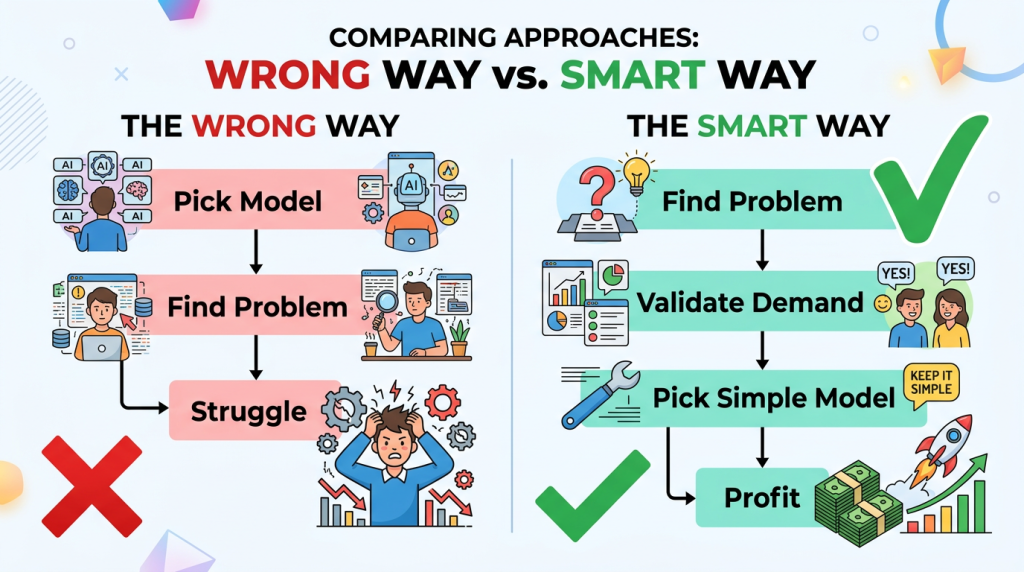
They pick a business model first.
They decide “I’m going to start a dropshipping store” or “I’m going to become an affiliate marketer” or “I’m going to sell online courses.” Then they try to find a product or problem that fits that model.
This is backwards. It’s like buying a plane ticket to “somewhere” and then trying to figure out why you’re going.
The smart way is the opposite:
Start with a problem you understand. Validate that people actually want it solved. Then pick the simplest possible business model to deliver the solution.
When you start with a problem, you never waste time building something nobody wants. You never pour months into the wrong model. You move fast, learn fast, and get your first sale fast.
Phase 1: Find Your “First Customer Problem”
A “first customer problem” isn’t a billion-dollar market gap. It’s a specific, painful, urgent problem that a small group of people will pay to solve right now.
Think small. Think specific. Think “this annoys me enough to spend $27.”
Here are 5 prompts to help you find problems you already understand:
1. What do people in your current job complain about constantly? (Even if you hate the job, you know the pain points.)
2. What problem did you recently solve for yourself? (Your struggle is someone else’s struggle.)
3. What question do you get asked repeatedly by friends or family? (People ask you because they trust you know the answer.)
4. What’s a task people in your hobby do manually that could be templated? (Spreadsheets, checklists, planners, prompts.)
5. What’s a common frustration in a Facebook group or subreddit you already follow? (Lurk for 10 minutes. You’ll see the same complaint over and over.)
How to validate the problem in 24 hours (free):
You don’t need a survey or a fancy tool. Go where your people already are:
If you find 5 people who say “yes, this is a real problem,” you’ve got a winner.
Phase 2: Build the “Embarrassingly Simple” Offer
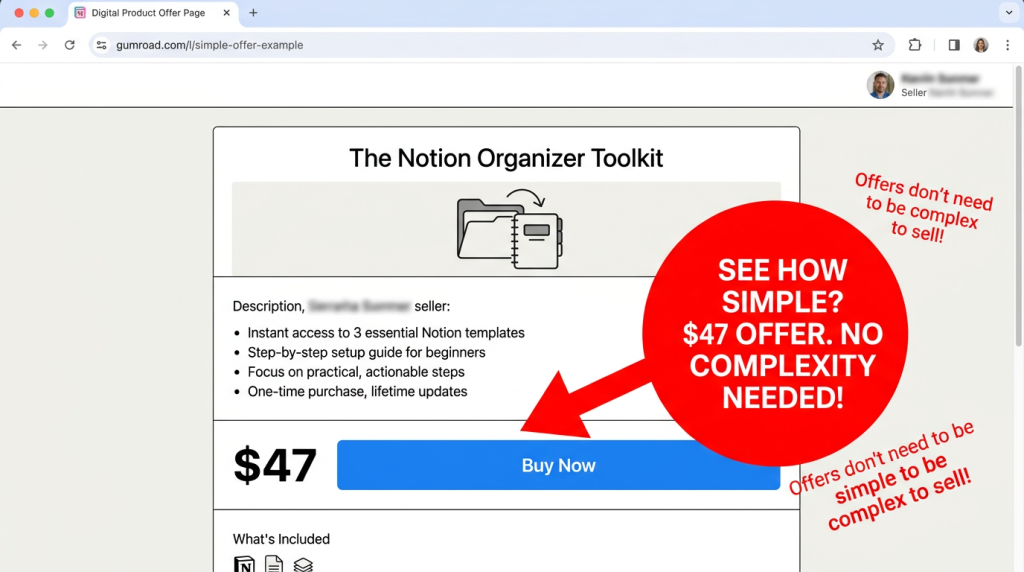
Your first offer should be three things: low-risk, low-price, and low-effort to deliver.
You are not building a $2,000 coaching program or a $500 course. You are building the smallest possible thing someone will pay for to solve their problem.
Examples of embarrassingly simple offers:
| Problem | Simple Offer | Price |
|---|---|---|
| “I don’t know what to post on social media” | 30-day content calendar template | $27 |
| “I waste time formatting my resume” | Resume template pack + ChatGPT prompts | $19 |
| “I can’t keep track of my job applications” | Job tracker Notion template | $15 |
| “My meeting notes are a mess” | Meeting notes template + automation guide | $24 |
| “I don’t know how to start a podcast” | Podcast launch checklist + equipment guide | $17 |
How to create the offer in one weekend using AI:
Phase 3: Find Your First 5 Customers (Without an Audience)
Most beginners think they need 10,000 followers to make a sale. That’s a lie. You need 5 people who have the problem you solve.
Here’s the “1-to-1 to 1-to-many” approach: start with direct outreach before you try to build an audience.
Three places to find your first customers (free):
1. People already asking for help in online communities
2. Former colleagues or classmates
3. Friends of friends who fit the profile
Your goal is 5 customers. Not 500. Not 5,000. Five.
Phase 4: Deliver, Learn, and Ask for the “Golden Question”
For your first 5 customers, your goal is not profit. Your goal is learning.
Over-deliver like crazy. Send them the product early. Offer a bonus. Ask them what they think.
Then ask the golden question:
“What would have made this 10x better?”
Not “did you like it?” Not “would you recommend it?” That gets you polite lies.
The golden question gets you truth. And truth is how you turn a $27 product into a $97 product. It’s how you discover the feature everyone actually wants. It’s how you find your real value proposition.
Take their answers. Improve the offer. Then go find the next 5 customers with a better product.
Your first 5 customers are your R&D team, not your retirement plan.
Aslam
Phase 5: Scale What Works (And Only What Works)
Most beginners try to scale before they have proof. They build the course, the website, the email sequence, and the ad campaign—all before anyone has bought anything.
That’s backwards.
Scale only after you have:
Simple scaling paths:
| Path | What It Means | When To Do It |
|---|---|---|
| Increase price | Raise from $27 to $47 after proving value | After 10+ sales |
| Create higher-tier offer | Add a $97 “deluxe” version with extras | After 20+ sales |
| Build an audience | Start a newsletter, TikTok, or blog | After you know exactly what to say |
| Automate delivery | Use Zapier or Gumroad to deliver instantly | Day one (do this immediately) |
The AI Advantage in Each Phase
AI isn’t a magic wand. But it’s a massive accelerator. Here’s how to use it in every phase:
| Phase | How AI Helps |
|---|---|
| Phase 1: Find Problems | Ask ChatGPT: “What are the 20 most common frustrations of [target audience]? Rank them by urgency.” |
| Phase 2: Create Offer | Use ChatGPT to write the entire product. Use Canva AI to design the cover. |
| Phase 3: Find Customers | Use AI to personalize outreach: “Take this template and make it sound like I’m talking to a busy working mom.” |
| Phase 4: Learn & Improve | Paste customer feedback into ChatGPT. Ask: “What are the 3 most common themes? What should I change?” |
| Phase 5: Scale | Use AI to generate 30 days of content from one product. Repurpose across platforms. |
You don’t need to be a tech wizard. You need to know how to type a prompt.
The “What If Nobody Buys?” Objection
This fear keeps more people stuck than anything else. Let me reframe it for you.
Traditional business thinking: “If nobody buys, I failed. I wasted time and money. I’m not cut out for this.”
Smart beginner thinking: “If nobody buys, I learned something valuable for the price of a few conversations. That’s not failure. That’s cheap market research.”
Here’s the truth: with the problem-first approach, you only build what someone has already told you they want. You validate before you create. You talk to customers before you write a single word.
The worst-case scenario isn’t failure. The worst-case scenario is staying stuck for another year, wondering “what if.”
And that costs you way more than a $27 product that didn’t sell.
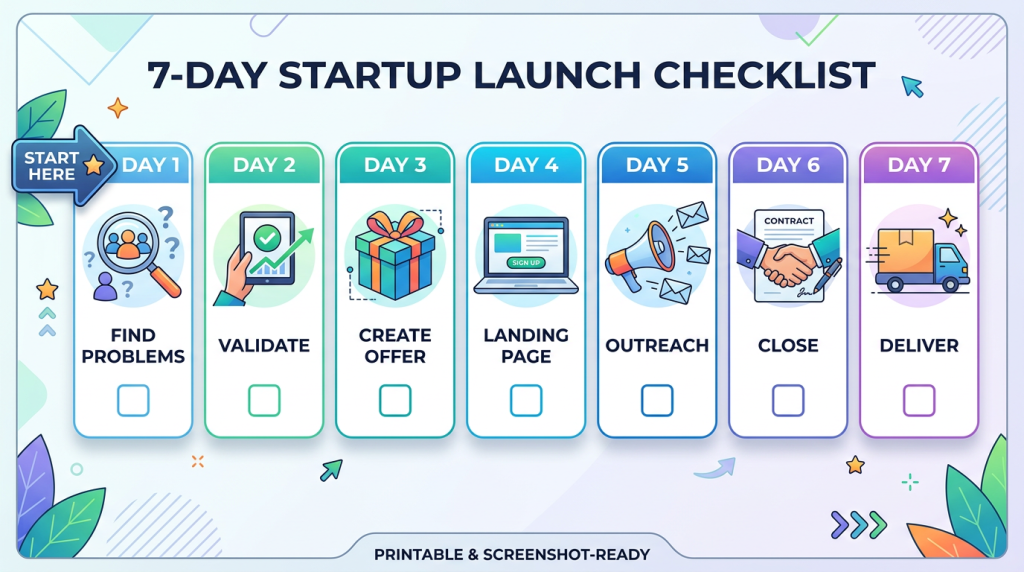
The 7-Day Smart Launch Plan
Here’s your exact roadmap. No guesswork. No overwhelm. Just one thing to do each day.
| Day | Action | Time Needed |
|---|---|---|
| Day 1 | Identify 3 potential problems using the 5 prompts from Phase 1 | 60 min |
| Day 2 | Validate the best problem with 5 people (Reddit, FB groups, or direct messages) | 90 min |
| Day 3 | Create the simple offer using ChatGPT and Canva AI | 2–3 hours |
| Day 4 | Build a simple landing page (Gumroad, Stan Store, or even a Typeform) | 30 min |
| Day 5 | Reach out to 10 potential customers using the scripts from Phase 3 | 60 min |
| Day 6 | Follow up and close first sales. Send reminders to anyone who hasn’t replied. | 30 min |
| Day 7 | Deliver the product and ask the golden question | 60 min |
That’s it. Seven days from zero to first customer.
You now have a smart framework: problem-first, embarrassingly simple offers, finding customers without an audience, and scaling only what works. You have the 7-day plan. You have the AI advantage.
But I know that reading a plan and executing it are two different things. It’s easy to close this tab, get busy with life, and tell yourself you’ll start “next week.”
That’s why I built something to help you take action.
Join the Free 7-Day Smart Launch Challenge (Benefit-Focused)
Problem Recap: You’re stuck in the cycle of wanting to start a digital business but feeling overwhelmed by conflicting advice, technical overwhelm, and fear of failure. Another week passes. Nothing changes.
Solution: I’ve created a free 7-Day Smart Launch Challenge that walks you through this exact framework with daily emails, video prompts, worksheets, and accountability check-ins. You don’t have to figure it out alone. Each day, you’ll get one clear task, a template to complete it, and a reminder to keep going.
Inside the challenge, you’ll also get access to a private community of other beginners doing the same thing—so you can ask questions, share wins, and stay motivated.
Action: Stop waiting for perfect conditions. They don’t exist. Click the button below, join the challenge for free, and take Day 1 action today.
[Join the Free 7-Day Smart Launch Challenge →]
P.S.
Here’s the thing about waiting: there will always be a reason to wait. More research to do. More skills to learn. More fear to overcome. But the only thing actually standing between you and your first sale is the decision to start. Join the challenge today. Your future self will thank you.
You don’t need an audience. You need 5 customers.
Aslam